

The Windows Calculator Story
Our calculator exists because of another one. When we set out to build our calculator engine in 2018, we didn't try to reinvent how a calculator should work, instead we looked at the one we already trusted, the Windows 7 calculator, and set out to make the web
version. This is the story of that calculator, and why we chose to follow its lead so
Quietly Evolving For Forty Years
The Windows calculator has shipped with Windows since the very first version in 1985. At the start, it was a plain arithmetic calculator and nothing more. A Scientific mode arrived in Windows 3.0, bringing roots, logarithms, and trigonometry. Over time it grew more capable while keeping the plain, familiar face, which is a part of why so many people reach for it without a second thought.
Math Under the Hood Got Serious
One change was more than just cosmetic. Through the mid-1990s the calculator did its math with standard floating-point arithmetic, the same approach most software uses, and the same one that produces small rounding quirks. From Windows 98 onward, Microsoft replaced that with an arbitrary-precision arithmetic library. Instead of being limited to a fixed number of binary digits, it could carry exact values for basic operations and 32 digits of precision for advanced ones. That's a rigorous math engine for a free, built-in tool, and it's one reason the Windows calculator earned the trust it has.
Windows 7 High Point We Built Toward
Windows 7 gave the calculator its most significant overhaul. The interface was redesigned, and alongside Standard and Scientific it added Programmer, Statistics, Unit Conversion, and Date Calculation modes. For us, the important addition was quieter: a multi-line history alongside predictable behavior for everyday calculation. The way the equals key repeated an operation, the way you could carry a result forward, the way the whole thing behaved the way you expected, that was the part worth preserving.
Why We Followed It So Closely
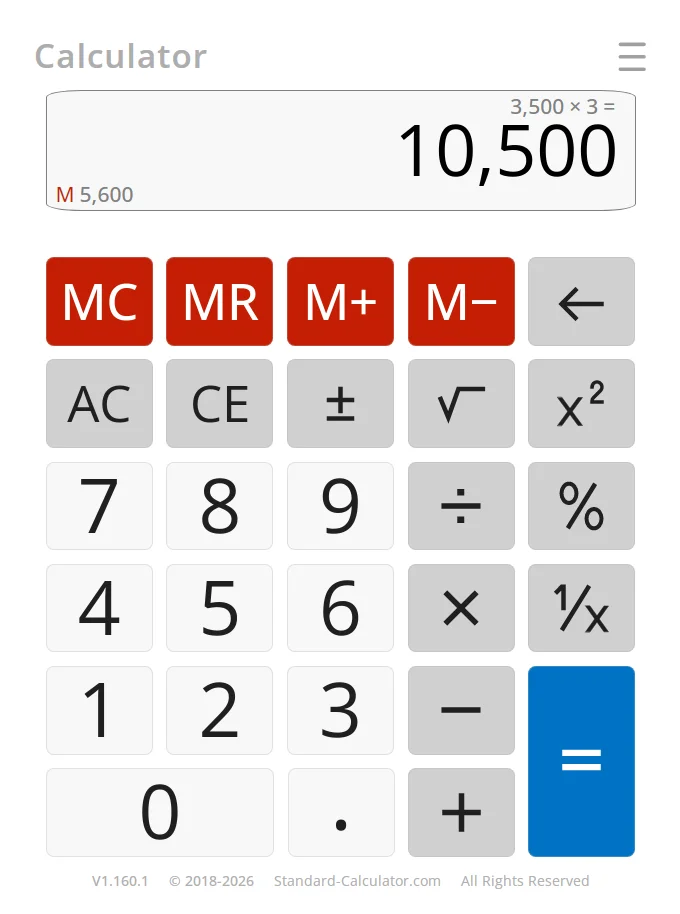
When we built our calculator engine in 2018, our research kept pointing back to the same conclusion: the Windows 7 calculator was the best-behaved calculator available. So we made a rule for ourselves.
Every time we added a function, we checked how Windows 7 handled it, and we matched that behavior as faithfully as we could. The repeating equals key, recalling a calculation from history, the way each operation responds. They're a careful reproduction of a tool that millions of people already know, so that using ours would require nothing new to learn.


One Place We Drew A Different Line
There's a single, honest difference between our calculator and the Windows original, and it's worth explaining. The Windows calculator runs that heavyweight 32-digit precision engine. Ours is built in JavaScript and works to 16-digit accuracy. We made that choice deliberately: writing our own arbitrary-precision math routines would have added enormous complexity for precision that virtually no one using an online calculator will ever need. For the everyday calculations this tool is built for, 16 digits is more than enough, and it keeps the calculator fast and light in your browser.
Interestingly, that heavyweight engine had a quirk of its own. For years, the Windows calculator would compute the square root of a perfect square and leave a microscopic error behind. Like when you calculate the square root of 4, subtract 2, and instead of a clean zero you'd get
something
-8.1648465955514287168521180122928e-39
It wasn't sloppiness; it came from how that advanced engine approximated square roots, and Microsoft eventually corrected it in a later Windows 10 update. Our simpler approach returns a clean zero for that calculation, not because our math is grander, but because we made different tradeoffs for a different purpose. We mention it only because it captures the philosophy: the right tool isn't the most powerful one, it's the one that behaves the way you expect for the job at hand.
Worth Respecting
In 2019, Microsoft open-sourced the Windows Calculator on GitHub, letting anyone study how it works. That openness fits a tool that earned its place through decades of getting the fundamentals right. We're not affiliated with Microsoft and this isn't their product, it's our own calculator engine, written from scratch. But we're glad to say where the inspiration came from.
We set out to bring the calculator we trusted to the browser, faithfully, and that's what we built.
Related . . .

